What is a freelance job? A freelance job is a self-employment arrangement where an individual provides professional services to multiple clients on a project or contract basis — without being permanently employed by any single company. Freelancers set their own hours, rates, and workload.
What Is a Freelance Job?
A freelance job is a form of work where you operate as an independent contractor — offering your skills to businesses, startups, or individuals without being on their payroll. Instead of a single employer, you can work with dozens of clients simultaneously, on your own schedule, from anywhere in the world.
The word freelance dates back to medieval times, referring to a mercenary knight who offered his lance (services) freely to different lords. Today the freelance job meaning is the same in spirit: you own your expertise and sell it project by project.
According to Upwork's freelancing research, over 64 million Americans freelanced in 2023 — and that number keeps growing. In 2026, what is a freelance job is no longer a niche question; it's the starting point for millions of careers.
Freelance Job Meaning — Key Characteristics
- ✅ Independent contractor status — you are your own boss
- ✅ Project-based or hourly pay — no fixed salary
- ✅ Multiple clients — diversified income streams
- ✅ Location flexibility — work from home, a café, or anywhere
- ✅ You set your rates — income scales with your skills and reputation
- ⚠️ You manage your own taxes and benefits — see IRS Self-Employed Tax Center
How Does Freelancing Work?
Understanding how a freelance job works is straightforward once you break it into its core cycle. Here's the typical workflow:
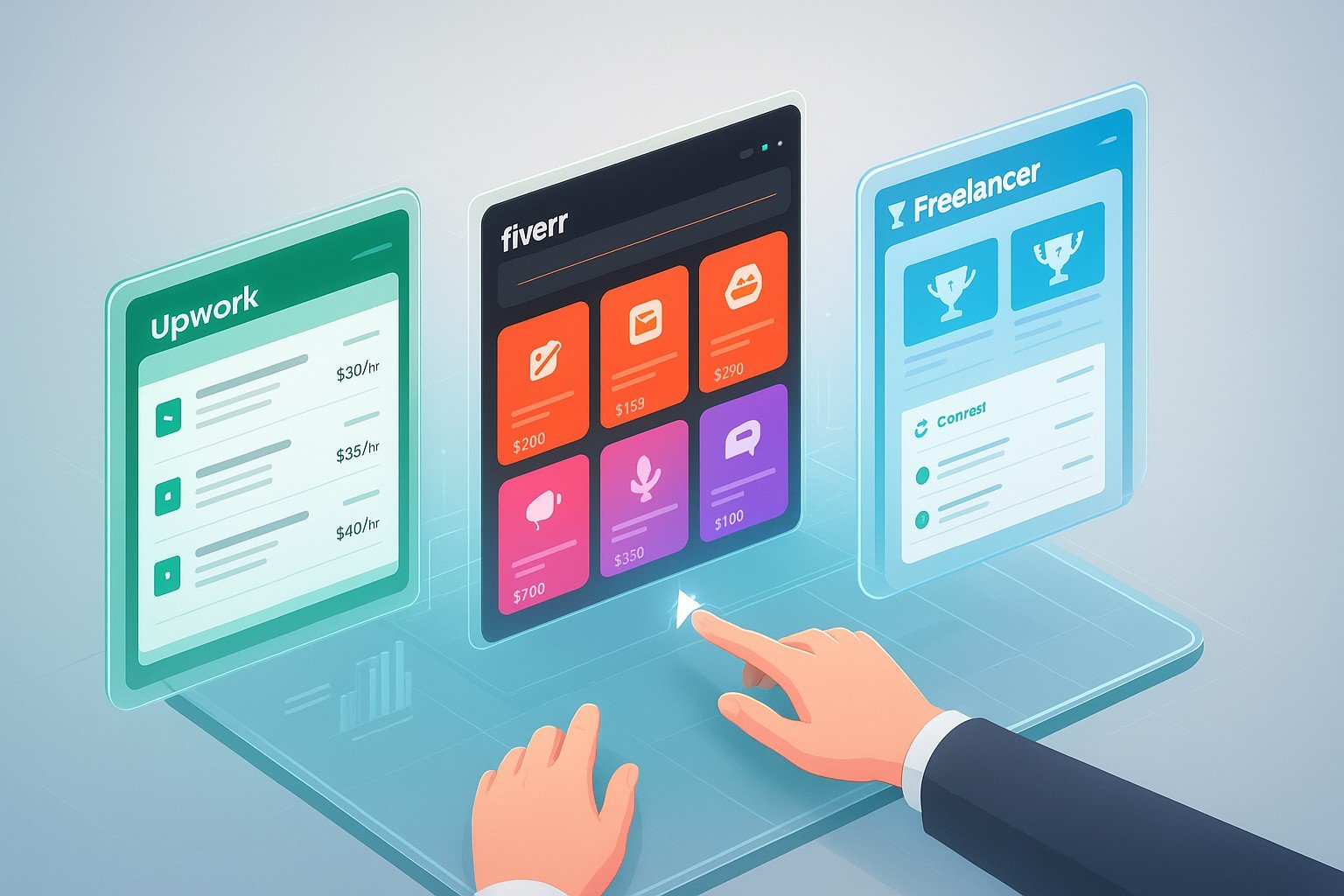
- Find a Client — via freelance platforms (Upwork, Fiverr), LinkedIn, cold outreach, or referrals from past clients.
- Agree on Scope & Rate — define deliverables, deadlines, revisions, and payment terms in a contract or platform agreement.
- Deliver the Work — complete the project to agreed specifications, communicating proactively if anything changes.
- Get Paid — via platform escrow (Upwork, Fiverr) or direct invoice through PayPal, Wise, or bank transfer.
- Collect Reviews & Repeat — positive reviews unlock higher-paying clients and better job opportunities.
The biggest difference from traditional employment is that you are responsible for finding your own work. This requires consistent marketing, networking, and portfolio-building — especially in the beginning.
Types of Freelance Jobs
One of the biggest misconceptions is that freelance jobs are only for writers or designers. In reality, almost any skill can be freelanced. Here are the most in-demand categories in 2026:
Writing & Content
Blog posts, copywriting, technical writing, ghostwriting, UX writing.
💰 $20–$150/hr
See Freelance Writer Jobs →Web Development
Frontend, backend, WordPress, Shopify, React, Python.
💰 $40–$200/hr
Graphic Design
Logo design, branding, social media graphics, UI/UX design.
💰 $25–$120/hr
Digital Marketing
SEO, Google Ads, social media management, email marketing.
💰 $30–$150/hr
Video & Audio
Video editing, motion graphics, voiceover, podcast production.
💰 $25–$100/hr
Business & Finance
Virtual assistant, bookkeeping, project management, consulting.
💰 $20–$100/hr
Want to explore remote-specific opportunities? See our guide to Remote Freelance Jobs →
Pros and Cons of Freelance Work
Before committing to freelance job work, it's important to weigh the real advantages against the genuine challenges. Here's an honest breakdown:
✅ Pros of Freelancing
- Freedom & flexibility — set your own hours and work location
- Unlimited income potential — raise rates as you gain experience
- Diverse work — work with different clients and industries
- No office politics — focus on doing great work, not corporate bureaucracy
- Tax deductions — home office, equipment, software, and more
- Skill growth — constant exposure to new challenges
⚠️ Cons of Freelancing
- Income instability — no guaranteed paycheck each month
- No employee benefits — health insurance, pension, paid leave are self-funded
- Self-discipline required — no manager to keep you accountable
- Client acquisition — finding steady work takes time and effort
- Isolation — working alone can feel lonely without community
- Self-employment tax — you pay both employer and employee portions
Freelance Job vs Full-Time Job: Key Differences
The freelance job vs full-time job debate comes down to what you value most — security and simplicity, or freedom and earning potential. Here's a direct comparison:
| Factor | 🟢 Freelance Job | 🔵 Full-Time Job |
|---|---|---|
| Income | Variable — project-based, can be higher | Fixed salary — predictable |
| Schedule | Fully flexible — you decide | Set hours — employer decides |
| Benefits | None provided — self-funded | Health, pension, paid leave |
| Job Security | Low — client-dependent | Higher — employment contract |
| Tax | Self-assessed quarterly | Withheld automatically by employer |
| Growth | Unlimited — raise rates anytime | Structured — annual reviews/promotions |
| Work Location | Anywhere — fully remote-ready | Often office or hybrid |
| Client/Boss | Multiple clients — you choose | One employer — assigned to you |
💡 Expert insight: Many professionals start with a full-time job and freelance on the side to test the waters before transitioning full-time. This hybrid approach reduces financial risk significantly.
How to Start Your First Freelance Job in 2026
Getting your first freelance job is the hardest step — but it's entirely achievable in days, not months, if you follow the right process.
Identify Your Marketable Skill
List everything you can do: writing, coding, design, data entry, translation, customer support, social media, video editing. Choose the one skill with the most demand and that you genuinely enjoy. Don't overthink — you can always add services later.
Build a Simple Portfolio (Even With No Experience)
Create 3–5 sample projects. Wrote a mock blog post? That's a portfolio piece. Designed a logo for a friend? Screenshot it. Coded a personal project? Put it on GitHub. Clients hire portfolios, not CVs.
Create Your Profile on a Freelance Platform
Register on Upwork, Fiverr, or Freelancer.com. Write a keyword-rich bio, set competitive entry-level rates, and upload your best portfolio samples. A complete profile gets 5× more views than an incomplete one.
Send Targeted Proposals (Quality Over Quantity)
Read the job post carefully. Address the client's specific problem in the first sentence. Mention a relevant sample. State your price and delivery time. Keep it under 150 words. Generic proposals are ignored — personalized ones win.
Over-Deliver, Collect Reviews, Scale
Your first project should make the client feel like they got twice what they paid for. Ask for a review once delivered. Those early reviews are the foundation of your freelance reputation — and your ticket to higher-paying clients.
Tools Every Freelancer Needs in 2026
Running a successful freelance job is easier with the right toolkit. Here are the essential categories and recommended tools:
🔍 Finding Work
- Upwork — best for long-term contracts
- Fiverr — best for packaged services
- LinkedIn — best for B2B clients
📄 Contracts & Invoicing
- AND.CO / HoneyBook — contract templates
- Wave — free invoicing for beginners
- FreshBooks — full accounting suite
💬 Client Communication
- Slack — team and client channels
- Loom — async video updates
- Calendly — meeting scheduling
📅 Project Management
- Trello — simple Kanban boards
- Notion — all-in-one workspace
- Toggl — time tracking for billing
💳 Getting Paid
- PayPal — universal, widely accepted
- Wise (Transferwise) — low-fee international transfers
- Stripe — professional invoicing and payment links
🛡️ Legal & Tax
- IRS Self-Employed Tax Center
- QuickBooks Self-Employed — tax tracking made easy
- Bonsai — freelance contracts + tax tools combined
FAQ About Freelance Jobs
Here are the most common questions beginners ask about what is a freelance job and how it works in practice.
What is a freelance job exactly?
A freelance job is a self-employment arrangement where you offer professional services to multiple clients on a contract or project basis, rather than working as a permanent employee for one company. You choose your own hours, clients, and rates — but you also manage your own taxes and benefits.
How does a freelance job work step by step?
Freelancing works in five steps: (1) find a client via a platform or outreach, (2) agree on the project scope and payment, (3) complete and deliver the work, (4) receive payment through the platform or invoice, and (5) collect a review and move to the next client.
Is a freelance job worth it in 2026?
Yes, for most skilled professionals, freelancing is worth it in 2026. The global freelance market continues expanding, remote work is fully mainstream, and experienced freelancers in writing, development, design, and marketing can out-earn traditional employees while working fewer hours.
What is the difference between a freelance job and a full-time job?
A full-time job means exclusive employment with one company — fixed salary, set hours, and employer-provided benefits. A freelance job means working independently for multiple clients, with flexible hours and potentially higher pay, but no automatic benefits and self-managed taxes.
How much can you earn from a freelance job?
Freelance earnings vary by skill and experience. Beginners typically earn $15–$25/hr, mid-level freelancers $30–$75/hr, and specialists in development, design, or consulting $100–$300/hr. Top-tier freelancers regularly earn $100,000+ per year working with premium clients.
Do I need experience to get my first freelance job?
No prior freelancing experience is required. Many beginners start with low-cost entry projects to build reviews, use portfolio pieces from personal or volunteer work, and gradually increase rates as they establish their reputation.
Continue Your Freelancing Journey
Ready to stop asking what is a freelance job and start living it?
Find Your First Freelance Job Now →