5 Types of Investment Funds Every Mid-Career Investor Should Know
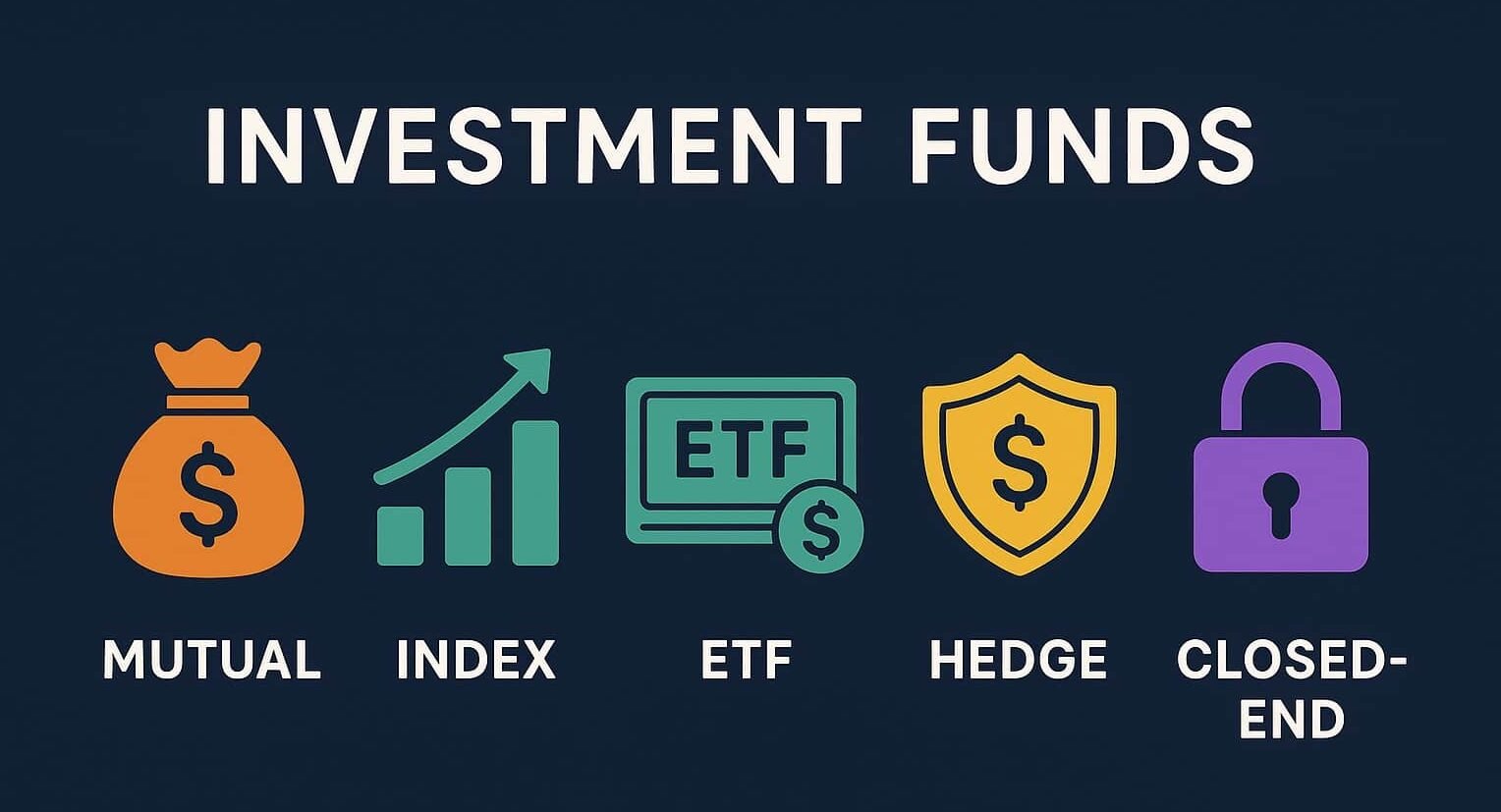
Think back to the last time you opened your retirement account and stared at a wall of fund names. Confusing, right? The truth is, however, that behind all that jargon there are really just five main types of investment funds — mutual funds, index funds, ETFs, hedge funds, and closed-end funds. Furthermore, each one works in a completely different way. This guide will walk you through all five clearly, so that by the end you will know exactly which ones deserve a place in your portfolio.
Table of Contents — Jump to a section
Section 1 Why fund choice matters more at 35–55
Here is the honest truth: mid-career is the most consequential window for building wealth. You are, in most cases, earning more than you were in your 20s. At the same time, however, you have more pulling at your income — mortgages, children, ageing parents. Moreover, retirement is close enough to feel real but still far enough away to do something meaningful about it.
The hidden cost of the wrong fund
Many investors overlook fees until it is too late. According to research by Vanguard, a difference of just 1% in annual fees — over 30 years — can reduce your final portfolio value by more than 25%. To put that another way: if you end up with £400,000, the wrong fund choice could have cost you £100,000 or more. That is not a rounding error; that is a life-changing amount.
Why most investors use too few fund types
Interestingly, research suggests that most individual investors use fewer than three fund types throughout their entire investing lifetime. As a result, they often miss out on options that would better match their age, risk tolerance, or income needs. Therefore, taking 10 minutes to understand all five types could be one of the highest-return activities you do this year.
The global investment fund industry now manages over $63 trillion in assets. Nevertheless, the vast majority of that money sits in just two or three fund categories. Broadening your awareness means broadening your options.
Section 2 The 5 types of investment funds — explained clearly
Let's go through each fund type one by one. For each one, I will cover what it is, how it actually works in practice, what it costs, and — most importantly — whether it makes sense for someone in their 30s, 40s, or 50s.
A mutual fund pools money from thousands of investors and hands it to a professional portfolio manager. That manager then buys and sells securities on the group's behalf, aiming to beat the market. Mutual funds are priced once per day after the market closes. As a result, you cannot trade them intraday the way you can with shares. They are one of the most widely used types of investment funds for 401(k) and IRA accounts, primarily because of their broad availability and regulated structure.
That said, the key downside is cost. Because an active manager is making decisions every day, you pay for that expertise — typically between 0.5% and 1.5% per year. Over decades, however, that fee gap can significantly erode your returns.
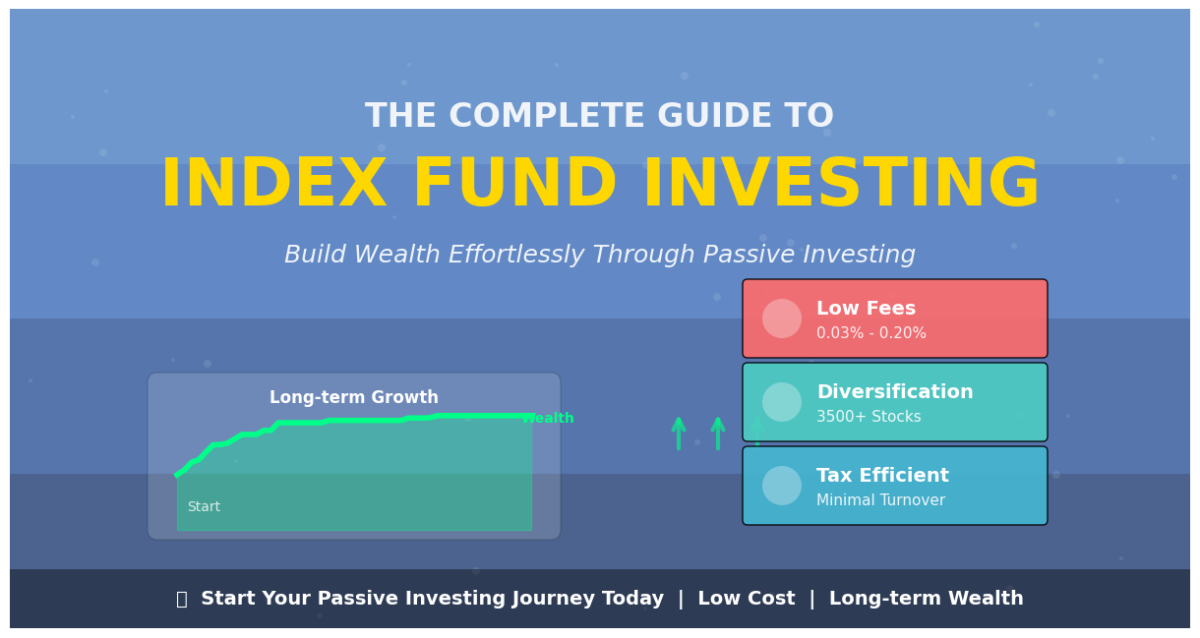
An index fund takes a completely different approach. Instead of trying to beat the market, it simply mirrors it. More specifically, it tracks a market index — such as the S&P 500 or the FTSE 100 — by holding the same stocks in the same proportions. Because no human is actively picking securities, fees are dramatically lower. For example, providers like Vanguard and Fidelity offer index funds with expense ratios as low as 0.03% per year.
For mid-career investors, furthermore, index funds have an additional advantage: they are remarkably tax-efficient because low turnover means fewer taxable events each year.
Think of an ETF as an index fund that trades like a stock. In other words, you can buy or sell it at any point during market hours — not just once a day like a mutual fund. This flexibility, combined with very low costs and strong tax efficiency, has made ETFs one of the fastest-growing types of investment funds in the world. Additionally, because there is no minimum investment (you can start with a single share), ETFs are accessible at any income level.
The U.S. Securities and Exchange Commission (SEC) provides detailed guidance on how ETF structures work and how they are regulated. It is well worth a read if you want the full technical picture.
Hedge funds are quite different from the other fund types on this list. They are private investment vehicles that use sophisticated strategies — short selling, leverage, derivatives — to generate returns regardless of whether markets are rising or falling. Consequently, they carry significantly higher risk than most retail investment options.
Moreover, hedge funds are not accessible to the general public. They are generally restricted to accredited investors with a net worth above $1 million or an annual income above $200,000. On top of that, fees follow the industry's "2 and 20" model — meaning you pay a 2% management fee every year plus 20% of any profits generated.
A closed-end fund raises a fixed amount of capital through an initial public offering (IPO), then lists its shares on a stock exchange. Unlike mutual funds, it does not issue new shares when more investors want in. Instead, you buy existing shares from other investors on the open market. As a result, the share price is determined by supply and demand rather than the fund's underlying asset value.
This creates an interesting dynamic: shares frequently trade at a discount to the fund's net asset value (NAV). For experienced income-focused investors in their 40s and 50s, therefore, this discount can represent a genuine buying opportunity — particularly in bond-focused or dividend-equity closed-end funds.
Section 3 Side-by-side comparison of all 5 fund types
Now that we have covered each fund individually, here is a quick reference table so you can compare them side by side. In particular, pay attention to the fee column — those differences compound dramatically over a 20-year horizon.
| Fund type | Annual fee | Management | Risk level | Best suited for | Min. entry |
|---|---|---|---|---|---|
| Mutual Fund | 0.5–1.5% | Active | Medium | Diversified growth | $500+ |
| Index Fund | 0.03–0.20% | Passive | Low–Med | Long-term wealth building | $1+ |
| ETF | 0.03–0.50% | Passive | Low–Med | Flexibility & tax efficiency | 1 share |
| Hedge Fund | 2% + 20% | Active | Very high | Accredited investors only | $1M+ net worth |
| Closed-End Fund | 0.5–2.0% | Active | Medium | Income & discounted NAV plays | 1 share |
Section 4 Which type of investment fund is right for your age?
Here is where things get personal. The best fund type for a 38-year-old with 25 years until retirement looks quite different from the best option for a 52-year-old planning to stop working in 10 years. Let's break it down by life stage.
If you are 35–45
Focus on growth. Low-cost index funds and broad-market ETFs are your best allies. Time is still on your side, so prioritise compounding over income.
If you are 45–55
Start blending in income. Closed-end bond funds and dividend ETFs can balance your portfolio as you shift from pure accumulation toward capital preservation.
Ages 35–45: make compounding do the heavy lifting
If you are in this group, you have one powerful advantage: time. Consequently, the most important thing you can do is keep costs low and stay invested consistently. A broad-market index fund — for example, one tracking the S&P 500 or a global equity index — gives you exposure to thousands of companies for a fraction of a penny per pound invested. Furthermore, because these funds require so little ongoing management, you avoid the temptation to tinker, which research consistently shows is one of the most damaging investor habits.
In addition, consider pairing your index fund core with a small allocation to sector ETFs in areas you understand — technology, healthcare, or clean energy, for instance. This allows you to express a view while still keeping your overall costs and risk manageable.
Ages 45–55: balancing growth with stability
As you approach 50, your priorities shift. While growth is still important, preserving what you have built becomes equally critical. Therefore, this is typically the phase where investors start introducing income-generating funds into their portfolio. Closed-end funds that specialise in investment-grade bonds or high-dividend equities, for example, can generate reliable monthly income while keeping volatility lower than a pure equity portfolio.
Our beginner's guide to investment funds covers how to build a simple income-generating portfolio even if you are starting later than you would like. It is never too late to make a meaningful difference.
Should you ever use an actively managed mutual fund?
This is a fair question and one that divides investors. The honest answer is: rarely, but not never. Research from S&P SPIVA reports consistently shows that over a 15-year period, more than 85% of actively managed mutual funds underperform their benchmark index after fees. Nevertheless, a small number of managers do consistently add value — particularly in niche markets like small-cap equities or emerging markets where information is less efficient.
The key, therefore, is scrutiny. If you are considering a mutual fund, check its 10-year track record net of all fees, compare it directly to its benchmark index, and ask whether the same manager is still in place. If it cannot clearly beat a comparable index fund after fees over a decade, there is very little reason to pay for it.
Consider building a "core and satellite" portfolio. Put 70–80% of your money into low-cost index funds or ETFs for broad, reliable market exposure. Then use the remaining 20–30% for more targeted positions — sector ETFs, income-focused closed-end funds, or one carefully selected active fund. This way, you get the best of both worlds: stability at the core and flexibility at the edges.
Section 5 How to start investing in funds today
The good news is that you do not need a financial adviser to get started. In fact, for most straightforward fund investments, a self-directed brokerage account is all you need. Here is a practical checklist to get moving.
Your step-by-step starting checklist
- First, open a tax-advantaged account — a 401(k), IRA, ISA, or TFSA depending on where you live. These accounts grow your investments either tax-free or tax-deferred, which makes an enormous difference over time.
- Next, decide on your asset allocation — that is, how much goes into equities versus bonds. As a starting point, many advisers suggest subtracting your age from 110 to find your equity percentage (e.g., at 45: 65% equities, 35% bonds).
- Then, choose 1–3 low-cost index funds or ETFs that cover different regions or asset classes. For example: a global equity index fund, a bond index fund, and perhaps a real estate ETF.
- After that, set up automatic monthly contributions — even £200 or $200 per month compounds significantly over 20 years. Automation removes emotion from the equation.
- Additionally, review your portfolio once a year and rebalance if any one fund has drifted significantly from your target allocation.
- Finally, resist the urge to react to short-term market moves. The investors who stay the course consistently outperform those who try to time the market.
Where to get regulated guidance
For official, regulated information in your region, the U.S. SEC's investor education portal is an excellent starting point. Similarly, if you are based in the UK, the Financial Conduct Authority (FCA) provides clear, unbiased guidance on investment funds and how they are regulated.
For deeper reading on fund selection and fees, our guide on low-cost index fund investing is also well worth your time.
Trusted external resources
- ↗ SEC — Mutual Funds & ETF Investor Guide
- ↗ FCA — UK Investment Guidance for Consumers
- ↗ Vanguard — Index Fund Overview & Options
- ↗ Fidelity — Index Fund Range
- ↗ S&P SPIVA — Active vs Passive Fund Performance Report
Still not sure which fund to pick first?
Our plain-English beginner's guide walks you through your first investment step by step — no jargon, no pressure, no prior knowledge required.
Read the Beginner's Guide →FAQ Frequently asked questions
What are the main types of investment funds?
Which fund type is best for investors aged 35 to 55?
What is the difference between a mutual fund and an index fund?
Are investment funds safe for mid-career investors?
Can I hold more than one type of investment fund at once?
Continue reading
Disclaimer: This article is for informational purposes only and does not constitute financial advice. Past performance is not a guarantee of future results. Always consult a qualified and regulated financial adviser before making investment decisions. See our full disclaimer and privacy policy.